
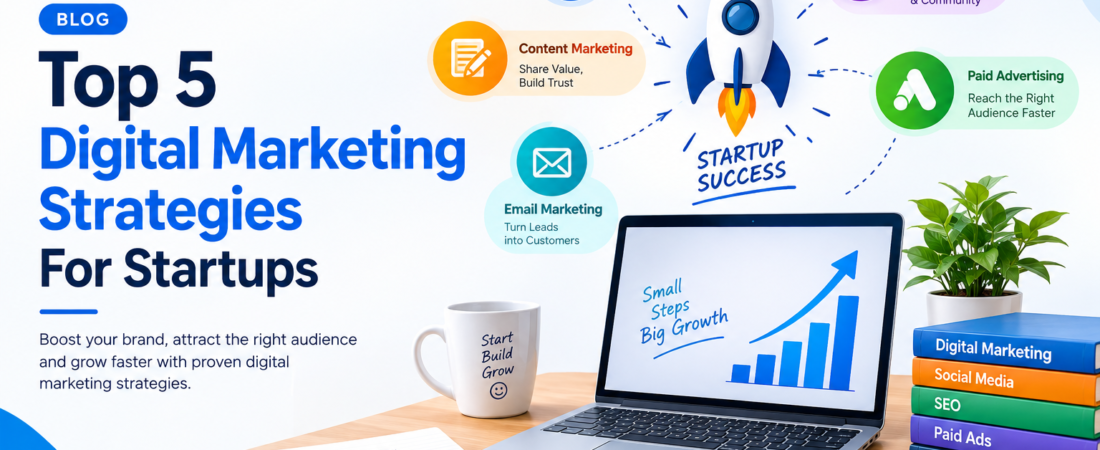
Starting a new business is exciting, but getting your brand noticed in a competitive market can be challenging. For startups, having a great product or service is only one part of the journey. You also need to reach the right audience, build trust, generate leads, and convert potential customers into paying customers.
This is where digital marketing for startups becomes essential.
Unlike traditional marketing, digital marketing allows startups to promote their products and services through cost-effective and measurable online channels. From search engines and social media to paid advertising and content marketing, startups can build a strong online presence without requiring a massive marketing budget.
In this blog, we will explore the Top 5 Digital Marketing Strategies For Startups that can help new businesses increase visibility, generate quality leads, build brand awareness, and achieve sustainable growth.
Why Digital Marketing Is Important For Startups
Startups often operate with limited resources, making it important to invest marketing budgets carefully. Digital marketing provides several advantages because businesses can target specific audiences, monitor campaign performance, and optimize their strategies based on real-time data.
A strong digital marketing strategy can help startups:
Build brand awareness
Reach potential customers online
Generate qualified leads
Increase website traffic
Improve customer engagement
Build credibility and trust
Increase sales and conversions
Compete with established businesses
The key is not to use every marketing channel at once. Startups should identify where their target customers spend time online and focus their resources on the channels that can produce meaningful results.
Let’s look at five important digital marketing strategies for startups.
1. Build a Professional and SEO-Friendly Website
Your website is often the first place where potential customers learn about your startup. A professional website can establish credibility and provide customers with important information about your business, products, services, and contact details.
A website should not simply look attractive. It should also be fast, mobile-friendly, easy to navigate, secure, and optimized for search engines.
Important Website Features For Startups
A startup website should ideally include:
Clear homepage messaging
About Us page
Products or Services page
Contact Us page
Strong call-to-action buttons
Mobile-responsive design
Fast loading speed
SSL security
Social media integration
Google Maps integration for local businesses
Lead forms
WhatsApp or call buttons
SEO-friendly content
For example, instead of simply writing “Welcome to Our Website,” your homepage can clearly communicate what your company offers and who it helps.
A professional website also creates a central destination for your digital marketing campaigns. Whether visitors discover your startup through Google, Instagram, Facebook, LinkedIn, or advertisements, they can visit your website to learn more and take action.
SEO and Your Startup Website
Search Engine Optimization, commonly known as SEO, helps your website become more visible when people search for relevant products or services on search engines.
Startups can begin with keyword research, optimized page titles, meta descriptions, headings, image alt text, internal linking, and valuable website content.
If you are building a startup from scratch, investing in a professional website and basic SEO can create a strong foundation for your future digital marketing efforts.
2. Use Social Media Marketing To Build Your Brand
Social media is one of the most accessible digital marketing channels for startups. Platforms such as Instagram, Facebook, LinkedIn, and YouTube allow businesses to communicate directly with potential customers.
However, simply creating social media accounts is not enough. Startups need a consistent social media marketing strategy.
Create Valuable and Relevant Content
Your content should provide value rather than constantly promoting your products.
Depending on your business, you can create:
Educational posts
Short-form videos
Product demonstrations
Customer testimonials
Behind-the-scenes content
Industry tips
Frequently asked questions
Case studies
Infographics
Company updates
For B2B startups, LinkedIn can be useful for professional networking, thought leadership, and reaching decision-makers. For consumer-focused businesses, platforms such as Instagram and Facebook can be useful for visual content, engagement, promotions, and customer communication.
Maintain Consistency
Consistency is more important than posting a large amount of content for a short period and then becoming inactive.
Create a monthly content calendar and determine:
What you will post
Which platform you will use
When you will publish
What audience you want to reach
What action you want users to take
A consistent social media presence can gradually improve brand recognition and customer engagement.
3. Invest In SEO and Content Marketing
SEO is one of the most important long-term digital marketing strategies for startups.
When potential customers search online for information, products, or services related to your business, appearing in relevant search results can bring valuable organic traffic to your website.
Unlike paid advertising, SEO focuses on improving your website’s organic visibility.
Keyword Research
Start by identifying keywords your potential customers are searching for.
For example, a startup offering website development services might target keywords such as:
Website development services
Website development for startups
Professional website development
Affordable business website
Digital marketing services
SEO services for small businesses
The keywords should be relevant to your services and match the search intent of your target audience.
Create Helpful Blog Content
Blogging can support both SEO and customer education.
A startup can create articles answering common questions, explaining industry concepts, comparing solutions, sharing guides, and addressing customer problems.
For example, a digital marketing company could publish topics such as:
Digital marketing strategies for startups
Benefits of professional websites
SEO tips for small businesses
How Meta Ads generate leads
Website features every startup needs
High-quality content can help attract organic visitors while positioning your business as a knowledgeable source within your industry.
Optimize Your Content With Rank Math
If your WordPress website uses Rank Math SEO, use it as a guide for optimizing your posts. Pay attention to your focus keyword, SEO title, meta description, URL structure, headings, internal links, image optimization, and readability.
However, avoid keyword stuffing. Your content should always be written primarily for people rather than search engines.
4. Use Paid Advertising To Generate Faster Results
SEO and organic social media can take time to build momentum. Paid advertising can help startups reach targeted audiences more quickly.
Popular platforms include Google Ads and Meta Ads, which cover advertising across Facebook and Instagram.
Google Ads
Google Ads can help startups reach people who are actively searching for specific products or services.
For example, someone searching for “website development company in Pune” may already have an interest in purchasing website development services.
Search advertising can therefore be useful for businesses targeting customers with specific purchase intent.
Meta Ads
Meta advertising can help startups reach audiences based on factors such as demographics, interests, behaviors, and online activity.
Startups can use Meta Ads for:
Lead generation
Website traffic
Brand awareness
Product promotion
Remarketing
Customer engagement
Start With a Controlled Budget
Startups do not necessarily need to spend a huge amount immediately.
Instead, begin with a clearly defined budget, audience, offer, and campaign objective. Track metrics such as:
Click-through rate
Cost per click
Cost per lead
Conversion rate
Return on advertising spend
Analyze the results and gradually allocate more budget to campaigns that are producing useful outcomes.
Paid advertising should be treated as a measurable process rather than simply boosting random posts.
5. Focus On Lead Generation, Email Marketing and Remarketing
Getting website visitors is only the beginning. The next challenge is converting those visitors into leads and eventually customers.
A startup should create clear conversion opportunities throughout its website and digital channels.
Use Strong Calls To Action
Examples include:
Get a Free Consultation
Request a Quote
Book a Demo
Contact Us
Download the Guide
Start Your Project
Talk To Our Team
A clear CTA tells visitors what they should do next.
Build an Email List
Email marketing can help startups maintain communication with prospects and existing customers.
Depending on the business, you can send:
Product updates
Educational content
Offers
Newsletters
Case studies
Industry insights
New service announcements
The goal should be to provide useful information instead of overwhelming subscribers with promotional messages.
Use Remarketing
Many visitors will not purchase or contact your business during their first visit. Remarketing allows businesses to reconnect with people who previously interacted with their website or marketing campaigns, where appropriate consent and platform requirements are met.
For example, someone may visit a service page but leave without submitting a form. A remarketing campaign can help bring the brand back to their attention later.
This makes remarketing a useful part of a broader startup digital marketing strategy.
How Startups Can Create A Digital Marketing Plan
The five strategies above work best when they are connected through a single marketing plan.
Startups can follow this simple process:
Step 1: Define Your Target Audience
Identify who your ideal customers are, what problems they have, and what motivates them to purchase.
Step 2: Set Clear Marketing Goals
Your goals could include increasing website traffic, generating leads, improving brand awareness, or increasing sales.
Step 3: Select The Right Channels
Choose the platforms that match your target audience and business objectives instead of trying to be active everywhere.
Step 4: Create Valuable Content
Develop useful content that answers customer questions and demonstrates your expertise.
Step 5: Track Performance
Use analytics and advertising dashboards to monitor traffic, leads, conversions, and campaign performance.
Step 6: Optimize Continuously
Digital marketing is not a one-time activity. Test different content, audiences, landing pages, advertisements, and offers to understand what works for your business.
Common Digital Marketing Mistakes Startups Should Avoid
While developing a digital marketing strategy, startups should avoid several common mistakes.
Ignoring the website: Social media profiles should not replace a professional business website.
Targeting everyone: A clearly defined audience generally makes marketing campaigns easier to structure and measure.
Posting without a strategy: Random content may not support specific business goals.
Ignoring SEO: Building organic search visibility can be valuable for long-term growth.
Spending without tracking: Advertising budgets should be monitored using meaningful performance metrics.
Expecting instant results: Some channels, particularly SEO and content marketing, require consistent effort and time.
Final Thoughts
Digital marketing gives startups multiple ways to build visibility, connect with potential customers, and grow their businesses. A professional website provides the foundation, while social media can strengthen brand engagement. SEO and content marketing can build long-term organic visibility, paid advertising can help generate targeted traffic and leads, and lead nurturing and remarketing can help businesses convert more opportunities.
The most important factor is consistency.
Instead of trying every marketing tactic simultaneously, startups should understand their audience, establish measurable goals, choose relevant channels, track performance, and continuously improve their strategy.
With the right combination of website development, SEO, social media marketing, paid advertising, content marketing, and lead generation, startups can build a strong digital presence and create a sustainable foundation for business growth.
Looking For Digital Marketing Services For Your Startup?
SG Web Technologies provides website development and digital marketing solutions designed for startups, businesses, and enterprises. Our services include website development, SEO, social media management, Meta Ads, Google Ads, LinkedIn Ads, and performance marketing.
Build your online presence, reach your target audience, and turn digital opportunities into business growth with a structured digital marketing strategy.
Frequently Asked Questions
1. What is the best digital marketing strategy for startups?
There is no single strategy that works for every startup. A combination of a professional website, SEO, social media marketing, paid advertising, and lead generation can create a comprehensive digital marketing approach.
2. How much should a startup spend on digital marketing?
The budget depends on the industry, target audience, competition, marketing goals, and available resources. Startups can begin with a controlled budget, measure results, and increase spending as they identify effective campaigns.
3. Is SEO important for startups?
Yes. SEO can help startups improve their organic visibility and attract people searching for relevant products and services. SEO is generally a long-term strategy that requires consistent optimization and quality content.
4. Should startups use Google Ads or Meta Ads?
Both platforms serve different purposes. Google Ads can reach users actively searching for specific products or services, while Meta Ads can help businesses reach targeted audiences across Facebook and Instagram. The appropriate choice depends on the startup’s goals and target audience.
5. How long does digital marketing take to produce results?
Results vary depending on the marketing channel, industry, competition, budget, website quality, and execution. Paid campaigns can generate data and traffic quickly, while SEO and content marketing generally require consistent long-term effort.